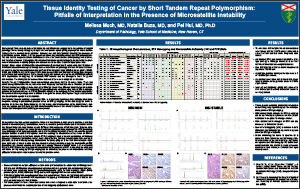
Tissue Identity Testing of Cancer by Short Tandem Repeat Polymorphism: Pitfalls of Interpretation in the Presence of Microsatellite Instability
Melissa Much, MD, Natalia Buza, MD, and Pei Hui, MD, PhD
Department of Pathology, Yale School of Medicine, New Haven, CT, USA
ABSTRACT
Background: Tissue mix-up and contamination are not infrequently encountered in the practice of surgical pathology. Tissue identity testing by analysis of short tandem repeat (STR) polymorphism offers discriminating power in resolving these problems. However, one rare but significant caveat is the presence of microsatellite instable tumors, in which genetic alterations may drastically change the STR polymorphism. This can lead to unexpected allelic discordance between the tumor and the corresponding normal tissue, and therefore erroneous interpretation. We examined how tissue identity testing can be altered by the presence of microsatellite instability (MSI) and what measures can be taken to avoid interpretation errors.
Design: Eleven cases of MSI-instable adenocarcinoma (9 intestinal and 2 endometrial) and 10 cases of MSI-stable adenocarcinoma (all colorectal) were selected from our pathology archives. All cases had been previously tested by immunohistochemistry (IHC) for DNA mismatch repair (MMR) proteins (MLH1, MSH2, MSH6 and PMS2) and by PCR using 5 NCI recommended MSI loci. DNA was extracted from microdissected tumor and normal tissues. Tissue identity testing was performed using the AmpFℓSTR® Identifiler® PCR amplification kit targeting 15 autosomal STR markers and the amelogenin locus for gender determination. The allelic patterns between tumor and normal tissue were compared in each case.
Results: Ten of 11 MSI-instable tumors demonstrated novel alleles at 5 to 12 loci per case. These loci varied among MSI-instable tumors, with some more frequently involved than others. However, all affected STR loci showed identifiable germline allele(s) in MSI-high tumors. One MSI-high tumor had no allelic alterations at any of the 15 STR loci, suggesting that genotyping may not detect every case of MSI. A wild-type germline allelic profile was seen in 7 of 10 MSI-stable tumors. In the remaining 3 cases isolated novel alleles were present at a unique single locus in addition to the germline alleles, likely representing the natural mutation rate of tandem repeats in microsatellites.
Conclusions: Genetic instability - particularly MSI - in tumors may significantly alter wild-type allelic polymorphism, leading to potential interpretation errors of STR genotyping. Before dismissing the tissue in question as a cancerous floater based on identity testing, careful examination of the allelic pattern, high index of suspicion and MSI testing by IHC and/or molecular methods are crucial to avoid erroneous conclusions and subsequent clinical and legal consequences.
©2013 Yale Department of Pathology. All rights reserved.
Any redistribution or reproduction of part or all of the contents in any form is prohibited. You may not, except with express written permission of the author or the Department of Pathology, distribute or commercially exploit the content, nor may you transmit it or store it in any other website or other form of electronic retrieval system, including use for educational purposes.