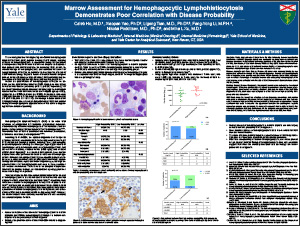
Marrow Assessment for Hemophagocytic Lymphohistiocytosis Demonstrates Poor Correlation with Disease Probability
Caleb Ho, M.D.1, Xiaopan Yao, Ph.D.2, Ligeng Tian, M.D., Ph.D.2,3, Fang-Yong Li, M.P.H.4, Nikolai Podoltsev, M.D., Ph.D.3, and Mina L Xu, M.D.1
Departments of 1Pathology and Laboratory Medicine, 2Internal Medicine (Medical Oncology), 3Internal Medicine (Hematology), Yale School of Medicine, and 4Yale Center for Analytical Sciences, New Haven, CT, USA
ABSTRACT
The current guidelines for diagnosing non-familial hemophagocytic lymphohistiocytosis (HLH) requires meeting 5 of 8 criteria, including evidence of hemophagocytosis, a non-specific finding. We performed a retrospective study of 64 bone marrow core biopsies and aspirates from patients with clinical suspicion for secondary HLH, or with incidental findings of hemophagocytosis, and evaluated for amount of hemophagocytic histiocytes on aspirates and on biopsies with aid of CD68 immunostaining. Separate review of medical records assigned patients to low (18 cases) or high (46 cases) HLH probability, and the association with histologic findings were examined using exact test.
Neither the quantification of hemophagocytic histiocytes on aspirate nor the quantification aided by CD68 staining on core biopsy correlated with disease probability (p=0.11, p=0.25, respectively). Of the clinical/laboratory criteria assessed, variables with the most significant correlations with HLH were ferritin level ≥10,000 ug/L (p = 0.02), cytopenias (p = 0.002) and fever (p = 0.002). Furthermore, with every 1,000 ug/L increase in ferritin level, the likelihood of HLH increases by 9% (OR: 1.09, 95% CI: 1.01-1.17). Our findings indicate that marrow histologic findings alone do not predict probability of HLH, and isolated finding of hemophagocytosis appeared to be of little value in diagnosing HLH due to lack of specificity.
©2013 Yale Department of Pathology. All rights reserved.
Any redistribution or reproduction of part or all of the contents in any form is prohibited. You may not, except with express written permission of the author or the Department of Pathology, distribute or commercially exploit the content, nor may you transmit it or store it in any other website or other form of electronic retrieval system, including use for educational purposes.